Multi-step
Until Goal Reached
Real
Actions, Real Consequences
DEV WORK
Claude
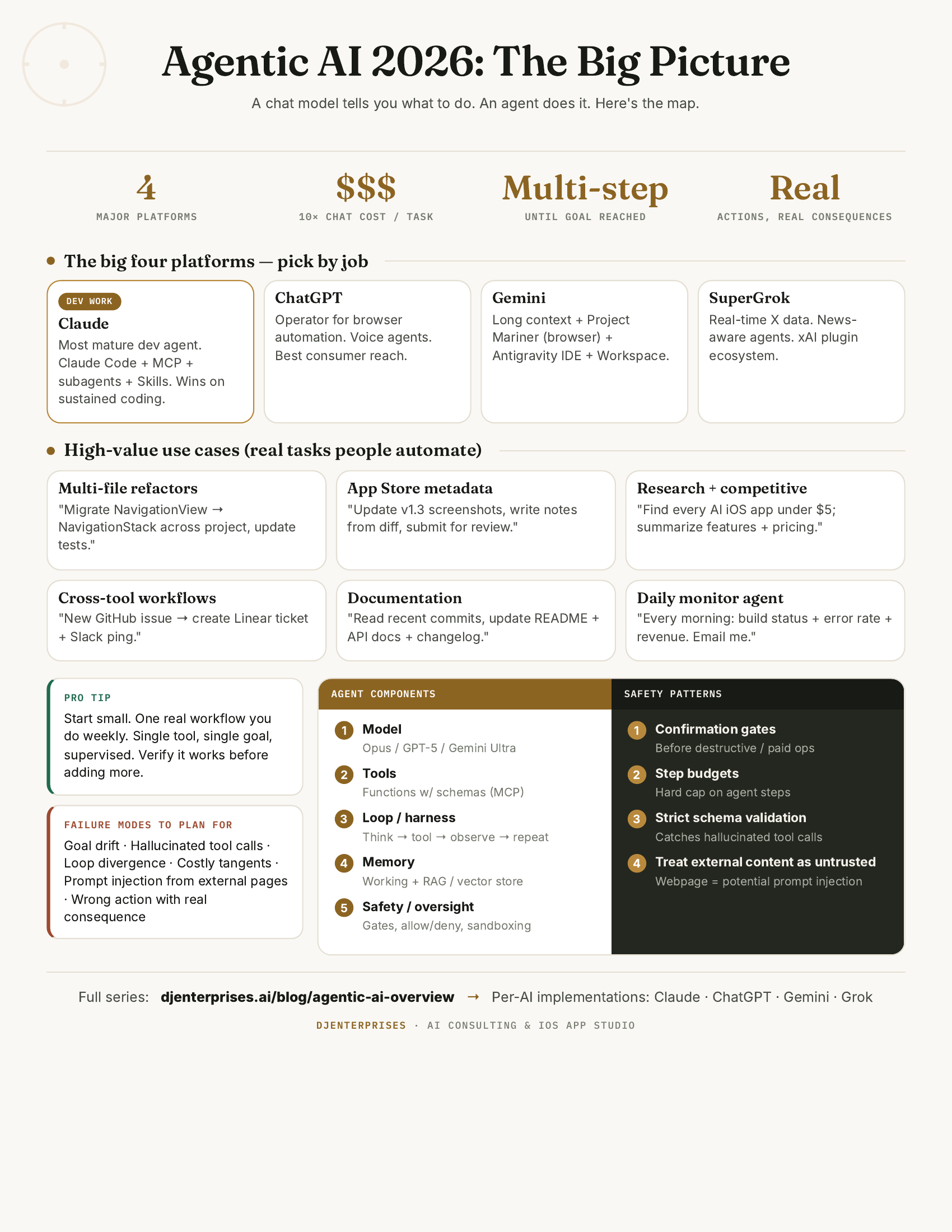
Most mature dev agent. Claude Code + MCP + subagents + Skills. Wins on sustained coding.
ChatGPT
Operator for browser automation. Voice agents. Best consumer reach.
Gemini
Long context + Project Mariner (browser) + Antigravity IDE + Workspace.
SuperGrok
Real-time X data. News-aware agents. xAI plugin ecosystem.
Multi-file refactors
"Migrate NavigationView → NavigationStack across project, update tests."
App Store metadata
"Update v1.3 screenshots, write notes from diff, submit for review."
Research + competitive
"Find every AI iOS app under $5; summarize features + pricing."
Cross-tool workflows
"New GitHub issue → create Linear ticket + Slack ping."
Documentation
"Read recent commits, update README + API docs + changelog."
Daily monitor agent
"Every morning: build status + error rate + revenue. Email me."
Pro Tip
Start small. One real workflow you do weekly. Single tool, single goal, supervised. Verify it works before adding more.
Failure Modes to Plan For
Goal drift · Hallucinated tool calls · Loop divergence · Costly tangents · Prompt injection from external pages · Wrong action with real consequence
Agent components
Safety patterns
- Model
Opus / GPT-5 / Gemini Ultra
- Tools
Functions w/ schemas (MCP)
- Loop / harness
Think → tool → observe → repeat
- Memory
Working + RAG / vector store
- Safety / oversight
Gates, allow/deny, sandboxing
- Confirmation gates
Before destructive / paid ops
- Step budgets
Hard cap on agent steps
- Strict schema validation
Catches hallucinated tool calls
- Treat external content as untrusted
Webpage = potential prompt injection
djEnterprises · AI consulting & iOS app studio