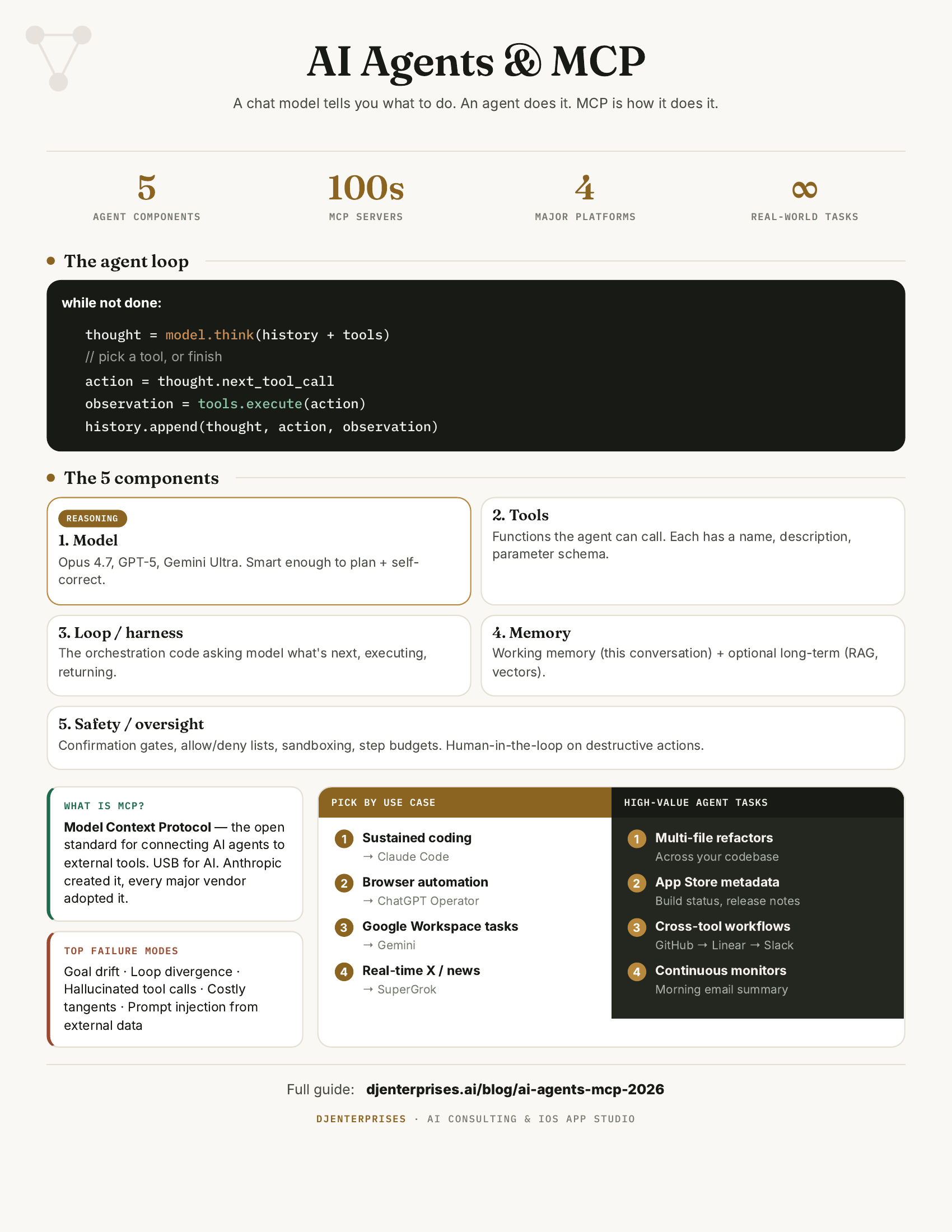
while not done:
thought = model.think (history + tools)// pick a tool, or finish tools.execute (action)
REASONING
1. Model
Opus 4.7, GPT-5, Gemini Ultra. Smart enough to plan + self-correct.
2. Tools
Functions the agent can call. Each has a name, description, parameter schema.
3. Loop / harness
The orchestration code asking model what's next, executing, returning.
4. Memory
Working memory (this conversation) + optional long-term (RAG, vectors).
5. Safety / oversight
Confirmation gates, allow/deny lists, sandboxing, step budgets. Human-in-the-loop on destructive actions.
What is MCP?
Model Context Protocol — the open standard for connecting AI agents to external tools. USB for AI. Anthropic created it, every major vendor adopted it.
Top Failure Modes
Goal drift · Loop divergence · Hallucinated tool calls · Costly tangents · Prompt injection from external data
Pick by use case
High-value agent tasks
Sustained coding → Claude Code Browser automation → ChatGPT Operator Google Workspace tasks → Gemini Real-time X / news → SuperGrok
Multi-file refactors Across your codebase App Store metadata Build status, release notes Cross-tool workflows GitHub → Linear → Slack Continuous monitors Morning email summary
djEnterprises · AI consulting & iOS app studio